
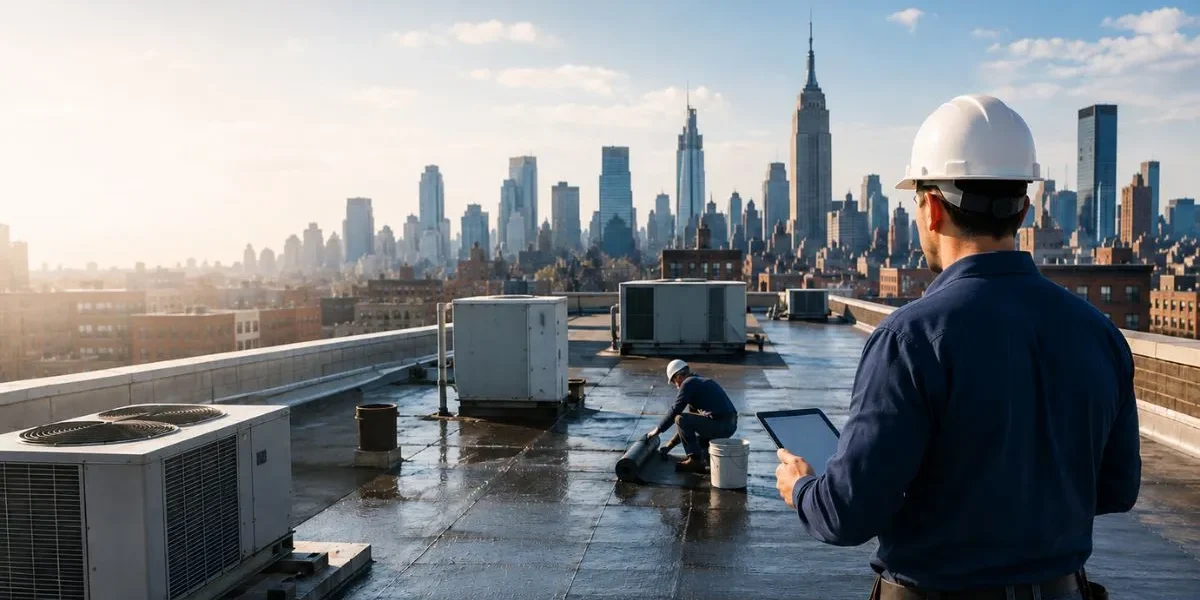
Commercial buildings in New York ask a lot from their roofs. A flat or low-slope roof has to handle heavy rain, snow, freeze-thaw cycles, rooftop equipment, foot traffic, drainage issues, and strict local rules. That is why roofing in new york is rarely just about stopping one leak. It is about protecting the building, reducing future risk, and making decisions that fit both the property and the code requirements.
For building owners, property managers, facility directors, and developers, commercial roof projects in New York often begin with a simple concern: water is getting inside. The real question is what caused it, how far the damage has spread, and whether a repair, coating, restoration, or replacement makes the most sense. The right answer depends on roof age, membrane condition, insulation, drainage, deck condition, and compliance needs.
This guide explains how roofing contractors new york property owners work with usually approach flat roof repair, cool roof planning, and compliance questions. It also shows how to compare roofing companies new york businesses may be considering, so you can make a practical decision instead of reacting only when a leak becomes urgent.
Why Commercial Flat Roofs Need a Different Kind of Attention
A commercial roof does not behave like a steep residential roof. Most commercial buildings use low-slope systems, which means water moves slowly and depends heavily on proper drainage. When drains clog, scuppers are blocked, or the roof surface settles, water can sit long enough to stress seams, flashings, and membrane laps.
That is one reason roofing new york projects often involve more than patching a visible opening. A leak may show up near a ceiling tile, but the actual entry point could be several feet away. Water can travel under a membrane, through insulation, around penetrations, or along structural elements before appearing indoors.
Common stress points on New York commercial roofs
Flat roofs in New York often fail around areas where materials meet, move, or get disturbed. These include:
- Drain bowls, scuppers, and internal drainage lines
- HVAC curbs and rooftop mechanical equipment
- Parapet walls and coping caps
- Seams in TPO, EPDM, modified bitumen, or built-up roofing
- Skylights, vents, pipe penetrations, and access hatches
- Areas with standing water after storms
Experienced roofing contractors new york businesses hire will usually inspect these areas first because they often reveal whether the problem is isolated or part of a larger roof performance issue.
Why quick patches are not always enough
A small patch can be useful when the roof is otherwise in serviceable condition. The problem comes when repeated patches are used to delay a larger decision. Imagine a warehouse roof with recurring ponding water near the same drain. Patching the membrane may stop water for a short time, but the drainage issue remains. Months later, the same area may fail again.
That is why a professional inspection matters. A new york roofing company should be able to explain what failed, why it failed, and what will happen if the underlying cause is ignored.
Flat Roof Repair Starts With Finding the Real Source of the Leak
Flat roof leaks can be deceptive. The stain inside the building is not always directly under the damaged area. Water may travel through wet insulation, cross low areas, or follow conduits and beams before it becomes visible.
For commercial roofing new york buildings, a proper leak investigation may include a visual roof inspection, moisture scanning, probe testing, drainage review, and interior ceiling review. The goal is to determine whether the issue is limited to the membrane surface or whether water has moved into insulation or the roof deck.
Repair is usually appropriate when damage is limited
A repair may be the right choice when the membrane is mostly intact, the insulation is dry, drainage is functioning, and the damage is limited to a seam, puncture, flashing, or small roof area. In that case, roofing contractors new york property managers work with can often make a targeted repair and recommend monitoring after the next major rain.
Restoration may fit aging roofs that still have useful life
Some roofs are not ready for full replacement but need more than spot repair. A coating or restoration system may help extend roof service life when the existing roof is structurally sound, dry enough, and compatible with the coating product. This is where testing matters. Applying a coating over trapped moisture can hide the problem instead of solving it.
Replacement becomes more likely when problems are widespread
Replacement may be the better decision when leaks are recurring, insulation is saturated, the membrane is brittle, roof attachment is poor, or deck damage is present. A roofing company new york owners choose should explain the trade-offs clearly, including disruption, staging, compliance requirements, and long-term maintenance needs.
Repair, Restoration, or Replacement: How to Think Through the Decision
Choosing the right path is easier when you separate symptoms from causes. A leak is a symptom. The cause may be poor drainage, failed flashing, aged membrane, wet insulation, damaged decking, or workmanship from a past installation.
| Roof Condition | Possible Option | What To Confirm First |
|---|---|---|
| One isolated puncture or open seam | Targeted repair | Membrane condition, dry insulation, no spreading damage |
| Aging roof with mostly sound surface | Restoration or coating | Moisture levels, adhesion, compatibility, drainage |
| Recurring leaks in several areas | Partial replacement or full replacement | Wet insulation, deck condition, code requirements |
| Structural deck damage | Replacement with deck repair | Permit requirements, engineering review, safety concerns |
This kind of decision framework helps when comparing roofing companies new york property owners may call for estimates. A low price may look attractive, but it should be measured against the scope of work, materials, warranty language, inspection process, and whether the contractor has addressed the actual cause.
Cool Roofs Are a Major Part of Commercial Roofing in New York
Cool roofs are designed to reflect more sunlight and absorb less heat than darker roof surfaces. In dense cities, dark roofs can contribute to heat buildup around buildings. A reflective roof surface can help reduce rooftop heat gain, especially on low-slope commercial buildings.
New York City also has rules tied to cool roof materials. The NYC Department of Buildings states that all roofs in New York City must be cool roofs, with some exceptions, meaning roof materials must meet solar reflectivity requirements. This is especially important when planning commercial roofing new york projects in the five boroughs.
NYC CoolRoofs also provides no-cost or low-cost cool roof installations for select eligible buildings, with priority for groups such as nonprofits, affordable housing, schools, hospitals, cultural centers, and other qualifying properties.
When a cool roof may make sense
A cool roof may be worth discussing when a building has a large low-slope roof, high cooling demand, dark existing roofing, aging membrane, or upcoming roof work that already requires material selection. For roofing in new york, cool roof planning should not be treated as a cosmetic choice only. It can affect code compliance, energy planning, and long-term roof strategy.
Cool roofs still need proper installation
Reflective material does not fix poor drainage, weak flashing, trapped moisture, or a failing deck. A new york roofing company should still inspect the full roof assembly before recommending coating or replacement. The roof has to work as a system, not just as a surface.
Compliance Tips for Commercial Roofing Projects in New York
Compliance can be one of the most confusing parts of roofing new york property owners face. Requirements may vary depending on location, building type, project scope, roof assembly, energy code triggers, and whether work involves the deck or only materials above the deck.
NYC Department of Buildings guidance says most construction in New York City requires approval and permits, although some minor alterations may not. The DOB also notes that a Professional Engineer, Registered Architect, or borough directors can explain filing and permit exceptions.
Know whether the work affects the roof deck
NYC rules distinguish between certain types of roof work. Roof repair or replacement limited to the membrane, roof coverings, cant strip, and insulation above the deck may not require a permit if the New York City Energy Conservation Code does not require additional thermal insulation. Roof repair or replacement that includes deck or sheathing replacement does require a permit.
That distinction matters when choosing roofing contractors new york building owners can rely on. The contractor should be clear about what is being removed, what is being replaced, and whether the work changes the roof assembly enough to trigger additional requirements.
Understand how Local Laws 92 and 94 may affect roof planning
Local Laws 92 and 94 relate to sustainable roofing requirements in New York City. DOB guidance explains that roofs must generally be cool roofs, with some exceptions, and that covered buildings may need solar photovoltaic systems, green roof systems, or a combination of sustainable roof zones where applicable.
For commercial roofing new york projects, this means roof replacement planning should involve more than selecting a membrane. Owners may need to consider roof area, obstructions, access, equipment layout, and whether solar or green roof requirements apply.
Remember Local Law 97 for larger buildings
Local Law 97 applies to most buildings over 25,000 square feet and sets greenhouse gas emissions limits that began in 2024, with stricter limits scheduled for 2030. NYC Accelerator also describes the law as setting annual carbon emissions caps for most buildings over 25,000 gross square feet.
A roof alone does not solve Local Law 97 compliance. Still, roofing decisions can affect insulation, cooling load, solar readiness, moisture control, and the long-term energy plan for the building. That is why a roofing company new york owners hire for larger properties should understand how roof work fits into broader building performance planning.
What Property Owners Should Ask Before Starting Roof Work
Before approving a proposal, ask questions that reveal whether the contractor understands the building, not just the visible damage.
- What is the likely source of the leak?
- Did you inspect drainage, flashings, penetrations, and parapet walls?
- Is the insulation dry or wet?
- Does this repair address the cause or only the symptom?
- Will the work involve the roof deck or only the roof covering?
- Could energy code, cool roof, solar, or green roof rules apply?
- What materials are being used, and are they compatible with the existing roof?
- How will rooftop equipment and tenant operations be protected during work?
- What maintenance does the roof need after completion?
These questions help separate experienced roofing companies new york businesses can trust from contractors who only provide a quick number without explaining the roof condition.
How to Compare Roofing Contractors in New York
Commercial roof work carries more risk than many owners expect. A poor repair can lead to interior damage, tenant complaints, business disruption, mold concerns, insulation failure, and premature replacement. The contractor you choose should have the technical experience and local understanding needed for the property.
When evaluating roofing contractors new york building owners should look for clear inspection notes, photos, scope details, material information, warranty terms, safety planning, insurance, licensing where required, and familiarity with local filing requirements. A proposal should be understandable. If it is vague, ask for clarification before signing.
A reliable new york roofing company will usually avoid promising that every leak can be solved with a simple patch. Some leaks can. Others need testing, drainage correction, flashing rebuilds, partial replacement, or full replacement. Honest diagnosis is more valuable than a fast guess.
Maintenance Tips That Reduce Emergency Roof Calls
Many emergency calls could have been avoided with routine inspections. For roofing in new york, the best maintenance schedule usually includes roof checks after major storms, before winter, after winter, and whenever rooftop contractors have worked around HVAC, signage, satellite equipment, or access points.
Commercial roof maintenance should include:
- Clearing drains, scuppers, and gutters
- Checking for ponding water
- Inspecting seams, flashings, coping, and penetrations
- Looking for punctures caused by foot traffic or tools
- Documenting roof conditions with photos
- Reviewing rooftop equipment supports and pitch pockets
- Checking interior signs of moisture before they spread
A good roofing company new york maintenance partner should help owners understand what needs immediate action and what can be monitored. Not every issue is an emergency, but ignoring small warning signs can make the next repair more expensive.
Signs Your Commercial Roof Needs Professional Attention
Some roof problems are obvious, such as active leaks during rainfall. Others develop quietly. Property managers should take the following signs seriously:
- Ceiling stains that return after storms
- Standing water that remains long after rainfall
- Bubbling, blistering, or splitting membrane
- Loose flashing around walls or equipment
- Interior odors near wet ceiling areas
- Soft areas underfoot on the roof surface
- Granule loss, cracking, or exposed reinforcement
- Repeated repairs in the same location
When these issues appear, commercial roof specialists can inspect the roof before damage spreads into insulation, decking, or interior finishes.
Choosing the Right Roofing Company for Your Building
Every commercial building has different demands. A retail property may need work staged around customer traffic. A warehouse may need leak control around inventory. A mixed-use building may need careful coordination with tenants. A school, medical facility, or nonprofit may have different budget and scheduling concerns.
That is why choosing a new york roofing company should be based on fit, not just price. The right team should understand flat roof systems, New York weather, commercial scheduling, drainage, code issues, safety, and communication. They should also explain the difference between short-term repair and long-term roof planning.
If you are comparing roofing companies new york wide, ask each one to explain their inspection method and why they recommend a specific solution. The answer will tell you a lot.
Frequently Asked Questions
How often should a commercial flat roof be inspected?
Most commercial roofs should be inspected at least twice a year and after major storms. For roofing in new york, seasonal changes make inspections especially useful before winter and after freeze-thaw conditions have passed.
Can a flat roof be repaired instead of replaced?
Yes, if the damage is limited and the roof assembly is still in good condition. Roofing contractors new york property owners call should confirm whether insulation, seams, flashings, and drainage are still performing properly before recommending repair only.
Are cool roofs required in New York City?
New York City generally requires roofs to be cool roofs, with exceptions, according to DOB guidance. The exact requirements can depend on project type, roof slope, roof area, and applicable code conditions, so confirm details before starting work.
Does every roof repair require a permit?
Not always. NYC rules identify some roof repair and reroofing work above the deck that may not require a permit under specific conditions, while work involving deck or sheathing replacement does require a permit.
What should I look for in a commercial roofing estimate?
Look for a clear scope of work, roof condition findings, photos, material details, warranty terms, project timeline, permit notes, safety planning, and what is excluded. A roofing company new york owners can trust should make the estimate easy to understand.
Planning Your Next Roofing Decision With Confidence
Commercial roofing is easier to manage when owners treat the roof as a building system rather than a surface that only needs attention during leaks. Flat roof repair, cool roof materials, drainage, insulation, permits, and emissions planning can all connect, especially in New York City.
The best approach is to start with a careful inspection, confirm the real cause of the problem, understand which compliance rules may apply, and compare proposals based on scope and reasoning. For commercial roofing new york properties, that kind of planning can reduce surprises and help owners make better long-term decisions.
If you are reviewing options for roofing new york buildings, work with a contractor who explains the roof clearly, documents the condition, and helps you choose the right path for the property. A thoughtful roofing company new york partnership can protect the building today while preparing it for the requirements and performance needs ahead.


